module main
using Bcube
using LinearAlgebra
using StaticArrays
using DelimitedFiles
include(joinpath(@__DIR__, "..", "common", "common.jl"))

const eps_h = 1.0e-10
const hmin₀ = 1.e-8
const hmax₀ = 1.0e10
const DMPcurv₀ = 0.0
const wall_friction = false
@warn "wall friction is $(wall_friction)"

velocity(h, hu) = (hu * 2 * h) / (h * h + max(h * h, (3e-5)^2))  #desingularization

function _flux_HLL(qL, qR, n, flux, f_λ)
    λL, λR = f_λ(qL), f_λ(qR)
    λ⁻ = min(minimum(λL), minimum(λR), zero(λL[1]))
    λ⁺ = max(maximum(λL), maximum(λR), zero(λL[1]))
    function f_HLL(qL, qR, fL, fR)
        if abs(λ⁺ - λ⁻) > 1.0e-12
            fLn, fRn = dotn(fL, n), dotn(fR, n)
            f = (λ⁺ * fLn - λ⁻ * fRn + λ⁻ * λ⁺ * (qR - qL)) / (λ⁺ - λ⁻)
        else
            f = 0.5 * (fL(qL) + fR(qR))
        end
        return f
    end
    map(f_HLL, qL, qR, flux(qL), flux(qR))
end

function shallow_water_maxeigval(q, gravity)
    h, hu = q
    u = velocity(h, hu)
    return norm(u) + √(norm(gravity) * max(h, eps_h))
end

function shallow_water_maxeigval(q, n, gravity)
    h, hu = q
    un = velocity(h, hu) ⋅ n
    return abs(un) + √(norm(gravity) * max(h, eps_h))
end

function shallow_water_eigval(q, n, gravity)
    h, hu = q
    un = velocity(h, hu) ⋅ n
    c = √(norm(gravity) * max(h, eps_h))
    return un - c, un + c
end

function compute_timestep!(q, mesh, dimcar, gn, CFL)
    h, hu = q
    degree = minimum(
        feSpace -> get_degree(Bcube.get_function_space(feSpace)),
        get_fespace.(get_fe_functions(q)),
    )

    λmax = var_on_centers(norm ∘ velocity(h, hu) + √(gn * h), mesh)
    Δt = CFL * minimum(dimcar ./ λmax)
    return Δt / (2degree + 1)
end

function flux_fitted(qi, qj, gni, gnj, Ri, Rj, φi, φj, nij, flux)
    hj, huj = qj
    _qj = (hj, Ri * huj)

    φ_hi, φ_hui = φi
    φ_hj, φ_huj = φj
    δφ = (φ_hi - φ_hj, φ_hui - transpose(Rj) * φ_huj)

    return flux(qi, _qj, gni, δφ, nij)
end

function flux_unfitted(qi, qj, gni, gnj, Pi, Pj, ℋi, ℋj, ϕi, ϕj, δφ, nij, flux)
    _nij = inv(I - ϕi * ℋi) * Pi * nij
    return flux(qi, qj, gni, δφ, _nij)
end

function flux_HLL(qi, qj, gni, δφ, nij)
    δv_h, δv_hu = δφ

    f_λ = x -> shallow_water_eigval(x, nij, gni)
    flux = _flux_HLL(qi, qj, nij, y -> flux_sw(y, gni), f_λ)

    flux_h, flux_hu = flux
    return flux_h ⋅ δv_h + flux_hu ⋅ δv_hu
end

function _flux_HLL(qL, qR, n, flux, f_λ)
    λL, λR = f_λ(qL), f_λ(qR)
    λ⁻ = min(minimum(λL), minimum(λR), zero(λL[1]))
    λ⁺ = max(maximum(λL), maximum(λR), zero(λL[1]))
    function f_HLL(qL, qR, fL, fR)
        fLn, fRn = dotn(fL, n), dotn(fR, n)
        if abs(λ⁺ - λ⁻) > 1.0e-12
            f = (λ⁺ * fLn - λ⁻ * fRn + λ⁻ * λ⁺ * (qR - qL)) / (λ⁺ - λ⁻)
        else
            f = 0.5 * (fLn + fRn)
        end
        return f
    end
    map(f_HLL, qL, qR, flux(qL), flux(qR))
end

function flux_sw(q, gn)
    h, hu = q
    u = velocity(h, hu)
    huu = hu * transpose(u)
    p_grav = 0.5 * gn * h * h
    return h .* u, huu + p_grav * I
end

function apply_limitation!(q, params, cache)
    h, hu = q
    dΩ = params.dΩ

    q_mean = Bcube.cell_mean(q, cache.cacheCellMean)

    lim_h, h_proj = linear_scaling_limiter(
        h,
        dΩ;
        bounds=(hmin₀, hmax₀),
        DMPrelax=params.DMPrelax,
        mass=cache.mass_sca,
    )
    set_dof_values!(h, get_dof_values(h_proj))

    _, hu_mean, = q_mean
    limited_var(a, a̅, lim_a) = a̅ + lim_a * (a - a̅)
    projection_l2!(hu, limited_var(hu, hu_mean, lim_h), dΩ; mass=cache.mass_vec)
end

"""
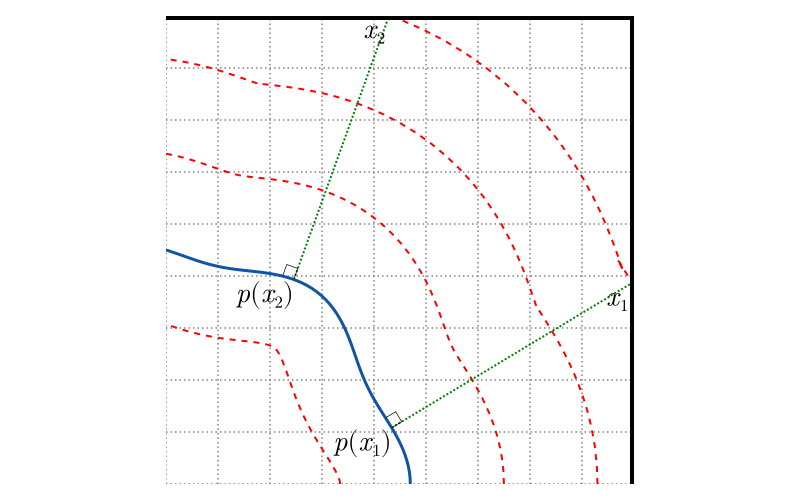
Define closest point interpolator of a function f : here we cheat because we now the closest point on Gamma,
which is assumed to be a circle of radius 1 centered in (0,0)
"""
function closest_point_interp_func(pf, f)
    return x -> begin
        θ = atan(x[2], x[1])
        Bcube.interpolate_at_point(pf, SA[cos(θ), sin(θ)], f...)
    end
end

closest_point_interp = PhysicalFunction ∘ closest_point_interp_func

"""
Warning : only valid for P1 geometrical elements
"""
function fitted_closest_point_interp_func(pf, f)
    return x -> begin
        icell = Bcube.find_cell_index(pf, x)
        cinfo = Bcube.CellInfo(pf.mesh, icell)
        ctype = Bcube.celltype(cinfo)
        @assert ctype isa Bcube.Bar2_t "not valid for elements different from P1"
        A, B = Bcube.nodes(cinfo)
        u = normalize(B.x - A.x)
        l = (x - A.x) ⋅ u
        H = A.x + l * u
        y = Bcube.CellPoint(H, cinfo, Bcube.PhysicalDomain())
        f_icell = Bcube.materialize(f, cinfo)
        return Bcube.materialize(f_icell, y)
    end
end

fitted_closest_point_interp = PhysicalFunction ∘ fitted_closest_point_interp_func


function unfitted_dg(;
    mesh,
    _ϕ,
    h0,
    u0,
    g,
    μ,
    tfinal,
    degree,
    CFL,
    flux,
    Δt_min=0.0,
    nitemax,
    use_constant_Δt=false, # if true, a constant Δt is used
    constant_Δt=0.0,
    limitation=degree > 0,
)
    (degree > 0 && !limitation) && @warn "degree > 0 but limitation disabled"

    # Mesh
    quad = Quadrature(QuadratureLobatto(), 2 * degree + 1)
    dΩ = Measure(CellDomain(mesh), quad)
    dΓ = Measure(InteriorFaceDomain(mesh), quad)
    dΛ = Measure(BoundaryFaceDomain(mesh), quad)
    nΓ = get_face_normals(dΓ)
    nΛ = get_face_normals(dΛ)
    dimcar = compute_dimcar(mesh)

    # Projection material
    ϕ = PhysicalFunction(_ϕ)
    ν = PhysicalFunction(x -> x ./ (norm(x) + 1e-20)) # analytic
    H = PhysicalFunction(x -> 1 / (norm(x) + 1e-20)) # analytic
    ℋ = PhysicalFunction(
        x -> begin
            x2 = x[1]^2
            y2 = x[2]^2
            return SA[
                y2 (-x[1]*x[2])
                (-x[1]*x[2]) x2
            ] ./ (x2 + y2)^(3 / 2)
        end,
    ) # analytic
    divℋ0 = PhysicalFunction(x -> -x ./ (norm(x) + 1e-20))
    P = I - (ν ⊗ ν)

    # FESpace
    U_h = TrialFESpace(FunctionSpace(:Lagrange, degree), mesh, :discontinuous)
    U_hu = TrialFESpace(
        FunctionSpace(:Lagrange, degree),
        mesh,
        :discontinuous;
        size=Bcube.spacedim(mesh),
    )
    V_h = TestFESpace(U_h)
    V_hu = TestFESpace(U_hu)
    U = MultiFESpace(U_h, U_hu)
    V = MultiFESpace(V_h, V_hu)

    # FEFunction
    q = FEFunction(U)
    projection_l2!(q, (h0, u0), mesh)

    # Gravity op
    gn = abs(g ⋅ ν)

    # Flux
    function flux_Γ(q, gn, P, ℋ, ϕ, φ, n)
        flux_unfitted ∘ (
            side⁻(q),
            side⁺(q),
            side⁻(gn),
            side⁺(gn),
            side⁻(P),
            side⁺(P),
            side⁻(ℋ),
            side⁺(ℋ),
            side⁻(ϕ),
            side⁺(ϕ),
            jump(φ),
            side⁻(n),
            flux,
        )
    end

    function _flux_Λ(qi, closest_q, gni, Pi, ℋi, ϕi, φi, nij)
        # Closest-point version
        qg = closest_q
        return flux_unfitted(qi, qg, gni, gni, Pi, Pi, ℋi, ℋi, ϕi, ϕi, φi, nij, flux)
    end
    function flux_Λ(q, closest_q, gn, P, ℋ, ϕ, φ, n)
        _flux_Λ ∘ (
            side⁻(q),
            side⁻(closest_q),
            side⁻(gn),
            side⁻(P),
            side⁻(ℋ),
            side⁻(ϕ),
            side⁻(φ),
            side⁻(n),
        )
    end

    function _flux_Ω(q, φ, ∇φ, gn, ν, P, ℋ, H, divℋ0, ϕ)
        h, hu = q
        u = hu / h
        φh, φhu = φ
        ∇φh, ∇φhu = ∇φ

        _q = (h, P * hu)
        f_h, f_hu = flux_sw(_q, gn)

        # Version Greer
        Pg = inv(I - ϕ * ℋ) * P
        ∇Γ_φh = Pg * ∇φh # scalar version
        ∇Γ_φhu = ∇φhu * Pg # vector version
        expr =
            f_h ⋅ (∇Γ_φh - φh * (H * ν - ϕ * divℋ0)) +
            f_hu ⊡ (∇Γ_φhu - φhu ⊗ (H * ν - ϕ * divℋ0))

        if wall_friction
            expr += -3μ * u / h ⋅ φhu
        end

        return expr
    end
    function flux_Ω(q, gn, P, ℋ, H, divℋ0, ϕ, φ)
        _flux_Ω ∘ (q, φ, map(∇, φ), gn, ν, P, ℋ, H, divℋ0, ϕ)
    end

    # Rhs function
    function compute_rhs!(rhs, qdofs)
        _q = (FEFunction(U, qdofs)...,)
        _closest_q = closest_point_interp(pf, _q)
        function l(φ)
            ∫(flux_Ω(_q, gn, P, ℋ, H, divℋ0, ϕ, φ))dΩ -
            ∫(flux_Γ(_q, gn, P, ℋ, ϕ, φ, nΓ))dΓ -
            ∫(flux_Λ(_q, _closest_q, gn, P, ℋ, ϕ, φ, nΛ))dΛ
        end
        assemble_linear!(rhs, l, V)
    end

    function compute_rhs(qdofs)
        rhs = zero(qdofs)
        compute_rhs!(rhs, qdofs)
        return rhs
    end

    # Mass matrix
    m(q, φ) = ∫(q ⋅ φ)Measure(CellDomain(mesh), 2 * degree + 1) # whole domain
    _M = assemble_bilinear(m, U, V)
    M = factorize(_M)

    # Limitation
    if degree > 0
        DMPrelax = DMPcurv₀ .* dimcar .^ 2
        params = (; dΩ, DMPrelax)
        cache = (
            mass_sca=Bcube.build_mass_matrix(U_h, V_h, dΩ),
            mass_vec=Bcube.build_mass_matrix(U_hu, V_hu, dΩ),
            cacheCellMean=Bcube.build_cell_mean_cache(q, dΩ),
        )
        apply_limitation!(q, params, cache)
    end

    # Loop
    t = 0.0
    last_ite = false
    rhs = Bcube.allocate_dofs(U)
    qdofs = copy(get_dof_values(q))
    for ite in 1:nitemax
        Δt = if !use_constant_Δt
            compute_timestep!(FEFunction(U, qdofs), mesh, dimcar, gn, CFL)
        else
            constant_Δt
        end
        Δt = max(Δt, Δt_min)
        if Δt > tfinal - t
            last_ite = true
            Δt = tfinal - t
        end

        qdofs .= get_dof_values(q)
        # udofs .= forward_euler(udofs, x -> M \ compute_rhs(x), Δt)
        qdofs .= rk3_ssp(qdofs, x -> M \ compute_rhs(x), Δt)

        t += Δt

        set_dof_values!(q, qdofs)
        limitation && apply_limitation!(q, params, cache)

        last_ite && break
    end

    return (; q, pf)
end

function run_one_case()
    # Settings
    R = 1 # radius
    CFL = 0.5
    tfinal = 0.5
    degree = 0
    outdir = joinpath(@__DIR__, "tmp")
    gn = 1.0
    ϕmax = 0.3
    n = 1024

    mkpath(outdir)

    # Initial solution / conditions
    μ = 5.0
    θc = 0.0
    θlr = π / 3
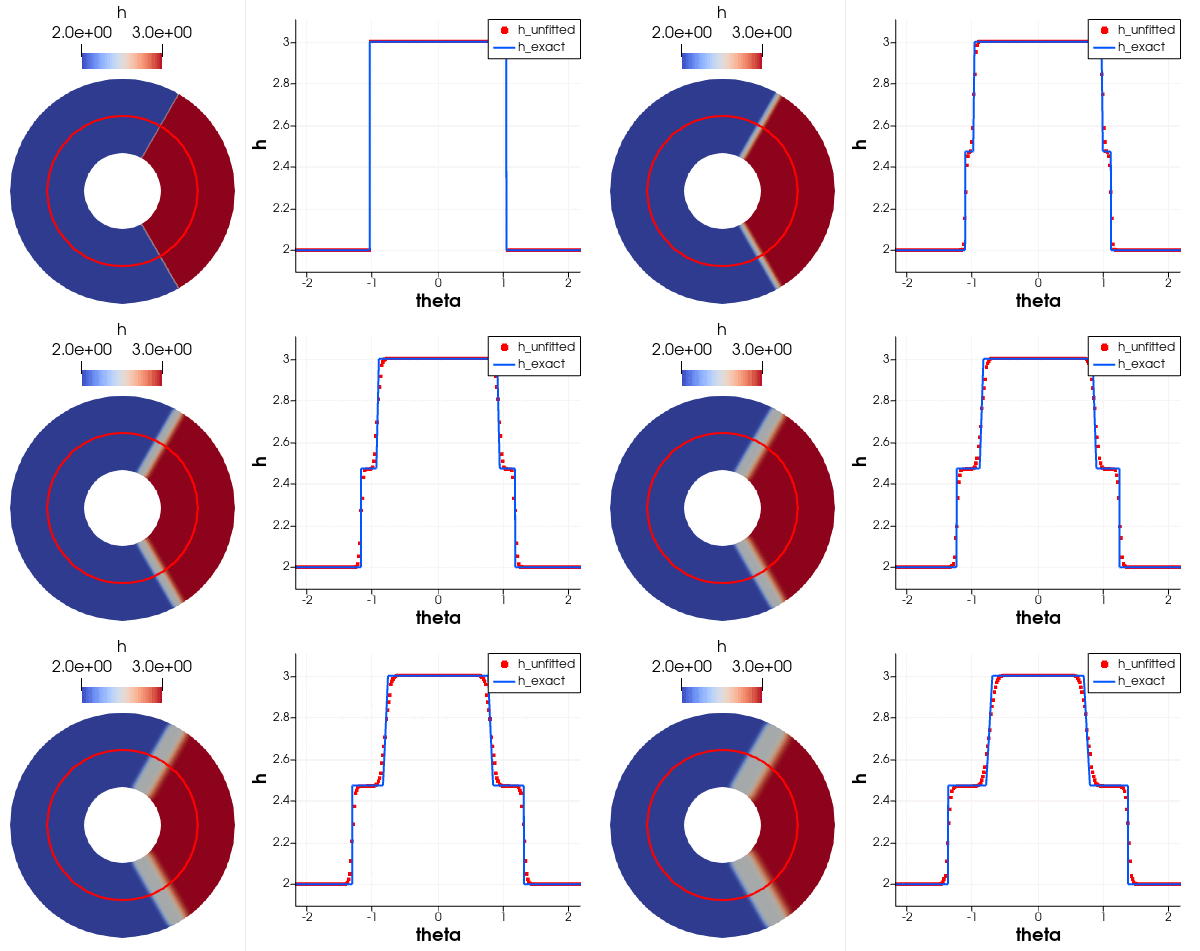
    hl0 = 3.0
    hr0 = 2.0
    _θ(x) = atan(x[2], x[1])
    u0 = PhysicalFunction(x -> @SVector zeros(Bcube.spacedim(mesh_fitted)))
    # h0 = PhysicalFunction(x -> abs(_θ(x) - θc) ≤ θlr ? hl0 : hr0)
    h0 = PhysicalFunction(
        x -> begin
            __θ = _θ(x) - θc
            if abs(__θ) ≤ θlr
                return hr0 + (hl0 - hr0) * exp(1 / θlr^2) * exp(-1 / (θlr^2 - __θ^2)) # wrong
            else
                return hr0
            end
        end,
    )
    function _g(x)
        if norm(x - xc) < 1e-9
            return SA[0.0, 0.0] # no gravity vector on center
        else
            return gn * normalize(x - xc)
        end
    end
    g = PhysicalFunction(_g)

    # Unfitted solution
    ϕ(x) = norm(x) - R # signed distance
    l = 3R

    ## Mesh 1
    println("UNFitted DG, n = $n, ϕmax = $ϕmax, degree = $degree")
    mesh_unfitted =
        rectangle_mesh(n, n; xmin=-l / 2, xmax=l / 2, ymin=-l / 2, ymax=l / 2)
    indices = Bcube.identify_cells(mesh_unfitted, x -> abs(ϕ(x)) < ϕmax)
    @assert length(indices) > 0 "no cell in clipped mesh" # the ϕmax is too harsh and there is no cell in the clipped mesh
    mesh_unfitted = Bcube.domain_to_mesh(CellDomain(mesh_unfitted, indices))
    if ncells(mesh_unfitted) <= 21 # check that all cells have at least one neighbor cell
        c2c = Bcube.connectivity_cell2cell_by_faces(mesh_unfitted)
        @assert c2c.minsize > 0 "disjoined cells"
    end

    sol_unfitted = unfitted_dg(;
        mesh=mesh_unfitted,
        _ϕ=ϕ,
        h0,
        u0,
        g,
        μ,
        tfinal,
        degree,
        flux=flux_HLL,
        CFL,
        nitemax=typemax(Int),
        Δt_min=0.0,
        limitation=false,
        use_constant_Δt=true,
        constant_Δt=CFL * l / (n - 1) / √(gn * max(hl0, hr0)) / (2degree + 1),
    )
end

run_one_case()

end